Nigerian citizens do not need a visa to enter Burkina Faso for stays of up to 90 days. As a member of ECOWAS (Economic Community of West African States), Nigeria benefits from the Protocol on Free Movement of Persons, which allows visa-free travel between all 15 ECOWAS member states. You only need a valid Nigerian passport and a yellow fever vaccination certificate. For stays longer than 90 days or for work and study purposes, you must apply for a long-stay visa through the eVisa portal or a Burkinabe embassy. This guide covers everything Nigerian passport holders need to know – entry requirements, documents, the ECOWAS withdrawal situation, and how to apply for a long-stay visa if needed.
Do Nigerian Citizens Need a Visa for Burkina Faso?
No, Nigerian citizens do not need a visa to enter Burkina Faso. Nigeria is one of the 15 ECOWAS member states whose citizens enjoy visa-free movement across the West African bloc. Under the Protocol on Free Movement of Persons, Right of Residence and Establishment (signed 30 April 1980), Nigerian passport holders can enter Burkina Faso and stay for up to 90 days without obtaining any visa.
This visa-free arrangement means:
- No embassy visit required for short stays (tourism, family visits, business meetings)
- No eVisa application needed – you simply arrive with your passport
- No visa fee to pay at the border
- Stay up to 90 days per visit without any formalities beyond passport control
The only documents you need at the port of entry are a valid Nigerian passport and proof of yellow fever vaccination. See our Burkina Faso visa-free countries guide for the complete list of exempt nationalities.
When Do Nigerians Need a Visa?
You need to apply for a visa if:
- Your stay will exceed 90 days
- You plan to work or study in Burkina Faso (requires a long-stay visa)
- You are traveling for purposes that require a residence permit
For long-stay visa options, see our Burkina Faso long-stay visa guide.
ECOWAS Free Movement: What It Means for Nigerians
The ECOWAS Protocol on Free Movement guarantees Nigerian citizens the right to enter, reside, and establish themselves in Burkina Faso without a visa. This protocol has been in force since 1980 and applies to all 15 member states.
How the Protocol Works in Practice
When you arrive at Ouagadougou Airport or a land border crossing, present your valid Nigerian passport to immigration officers. They will:
- Verify your identity – check your passport photo matches
- Record your entry – stamp your passport with the entry date
- Check your yellow fever certificate – mandatory for all entrants
- Allow entry – no visa sticker, no fee, no application form
The entire process takes 5 to 15 minutes at the airport and can be longer at busy land border crossings.
Important: ECOWAS Withdrawal Situation
In January 2024, Burkina Faso, Mali, and Niger announced their withdrawal from ECOWAS, forming the Alliance of Sahel States. While this withdrawal has been signalled, as of mid-2026 the free movement protocol continues to apply for Nigerian citizens traveling to Burkina Faso.
However, this situation is evolving. The Alliance of Sahel States could implement its own border policies independent of ECOWAS. Nigerian travelers should:
- Monitor news about the Alliance of Sahel States’ travel policies before booking
- Check with the Burkina Faso Embassy in Abuja if traveling for extended stays
- Carry both a valid Nigerian passport and, if available, an ECOWAS travel document
Entry Requirements for Nigerian Citizens
Even though Nigerians do not need a visa, you must meet specific entry requirements at the port of arrival. Failure to meet these requirements can result in denied entry.
Valid Nigerian Passport
Your Nigerian passport must have:
- At least 6 months of validity remaining from your intended date of entry
- At least 2 blank pages for entry and exit stamps
- A clear photo page – damaged or faded passports may be rejected
If your passport has less than 6 months validity, renew it at the Nigeria Immigration Service (NIS) before traveling. Passport renewal in Nigeria typically takes 2 to 6 weeks depending on the processing center.
Yellow Fever Vaccination Certificate
A yellow fever vaccination certificate is mandatory for all travelers entering Burkina Faso, including Nigerians. This is enforced at the port of entry by Burkinabe immigration authorities.
Key details for Nigerian travelers:
- Where to get vaccinated: Federal Ministry of Health quarantine centers at international airports (Lagos Murtala Muhammed, Abuja Nnamdi Azikiwe, Port Harcourt) and designated state hospitals
- Cost: Approximately NGN 2,000 to NGN 5,000 at government centers
- Timing: Get vaccinated at least 10 days before travel – the certificate is only valid after this period
- Certificate: You will receive an International Certificate of Vaccination (yellow card). Carry the original document – photocopies are not accepted
- At the border: Officers check the yellow card at immigration. Travelers without a valid certificate may be denied entry or vaccinated on the spot at their own expense
Proof of Accommodation
Immigration officers may ask for proof of where you will stay in Burkina Faso. Acceptable documents include:
- Hotel booking confirmation (printed or on your phone)
- Invitation letter from a host in Burkina Faso (with their address and phone number)
- Reservation at a guesthouse or Airbnb
While this is not always checked, having it ready prevents delays at the border.
Sufficient Funds
You may be asked to demonstrate you have enough money for your stay. There is no officially published minimum, but carrying the equivalent of at least 50,000 FCFA per day (approximately NGN 65,000) is recommended. This can be in cash, bank statements, or a combination.
Return or Onward Ticket
Having a return ticket or proof of onward travel is not always required but can speed up your entry process. Airlines may also check this before allowing you to board.
How to Travel from Nigeria to Burkina Faso
There are no direct flights from Nigeria to Burkina Faso. Nigerian travelers must connect through a hub city. The most common routes are:
| Route | Airlines | Approximate Flight Time | Approximate Cost (NGN) |
|---|---|---|---|
| Lagos – Lome – Ouagadougou | ASKY Airlines | 4-6 hours | 250,000 – 450,000 |
| Lagos – Abidjan – Ouagadougou | Air Cote d’Ivoire | 5-7 hours | 300,000 – 500,000 |
| Lagos – Casablanca – Ouagadougou | Royal Air Maroc | 8-12 hours | 400,000 – 700,000 |
| Abuja – Addis Ababa – Ouagadougou | Ethiopian Airlines | 10-14 hours | 350,000 – 600,000 |
| Lagos – Paris – Ouagadougou | Air France | 12-16 hours | 500,000 – 900,000 |
The most practical route for most Nigerians is via Lome (Togo) on ASKY Airlines, which offers the shortest travel time and competitive fares. Book through the ASKY website or a travel agent in Lagos or Abuja.
Overland Travel from Nigeria
It is possible to travel overland from Nigeria to Burkina Faso, passing through Niger (the country). The route is:
Lagos – Abuja – Sokoto – Niger border – Niamey – Burkina Faso border – Ouagadougou
This journey takes approximately 24 to 36 hours by road and is not recommended for first-time travelers due to:
- Security concerns in parts of Niger (particularly near the Mali and Burkina Faso borders)
- Multiple border crossings requiring passport stamps at each point
- Poor road conditions in some stretches
- Limited transport options between border towns
If you do travel overland, carry your passport, yellow fever certificate, sufficient cash (CFA francs), and photocopies of all documents.
Currency and Money for Nigerians in Burkina Faso
Burkina Faso uses the West African CFA franc (FCFA), which is different from the Nigerian naira (NGN). The CFA franc is pegged to the euro at a fixed rate of 1 EUR = 655.957 FCFA.
How to Get FCFA from Nigeria
- Convert NGN to EUR or USD in Nigeria – at a bureau de change in Lagos (Wuse, Victoria Island) or Abuja
- Exchange EUR/USD to FCFA at banks or exchange offices in Ouagadougou
- Avoid carrying large amounts of cash – use a combination of cash and cards
ATM and Card Usage
- ATMs are available in Ouagadougou and Bobo-Dioulasso, operated by banks like Ecobank, BOA, and BICIG
- Visa and Mastercard are accepted at ATMs, but Nigerian bank cards may have daily withdrawal limits and foreign transaction fees
- Inform your Nigerian bank before traveling to avoid your card being blocked for suspicious international activity
- Cash is king for most transactions outside major hotels and restaurants
Exchange Rate Reference
| Currency | Approximate Rate |
|---|---|
| 1 USD | ~605 FCFA |
| 1 EUR | 655.96 FCFA |
| 1 NGN | ~0.38 FCFA |
| 10,000 FCFA | ~NGN 26,000 |
Exchange rates fluctuate. Check the current rate before traveling.
Long-Stay Visa for Nigerians: When You Need One
Nigerian citizens who plan to stay in Burkina Faso for more than 90 days, or who intend to work, study, or reside there, must apply for a long-stay visa. The ECOWAS free movement protocol only covers short stays.
Long-Stay Visa Types
| Visa Type | Duration | Purpose | Fee |
|---|---|---|---|
| Work visa | 1 year (renewable) | Employment in Burkina Faso | 77,000 FCFA (~$124) |
| Student visa | Duration of studies | Enrolled at a Burkinabe institution | 55,000 FCFA (~$89) |
| Family reunification | 1 year (renewable) | Joining a family member resident in BF | 55,000 FCFA (~$89) |
| Business visa (long) | 1 year (renewable) | Running a business in BF | 93,500 FCFA (~$151) |
How to Apply for a Long-Stay Visa
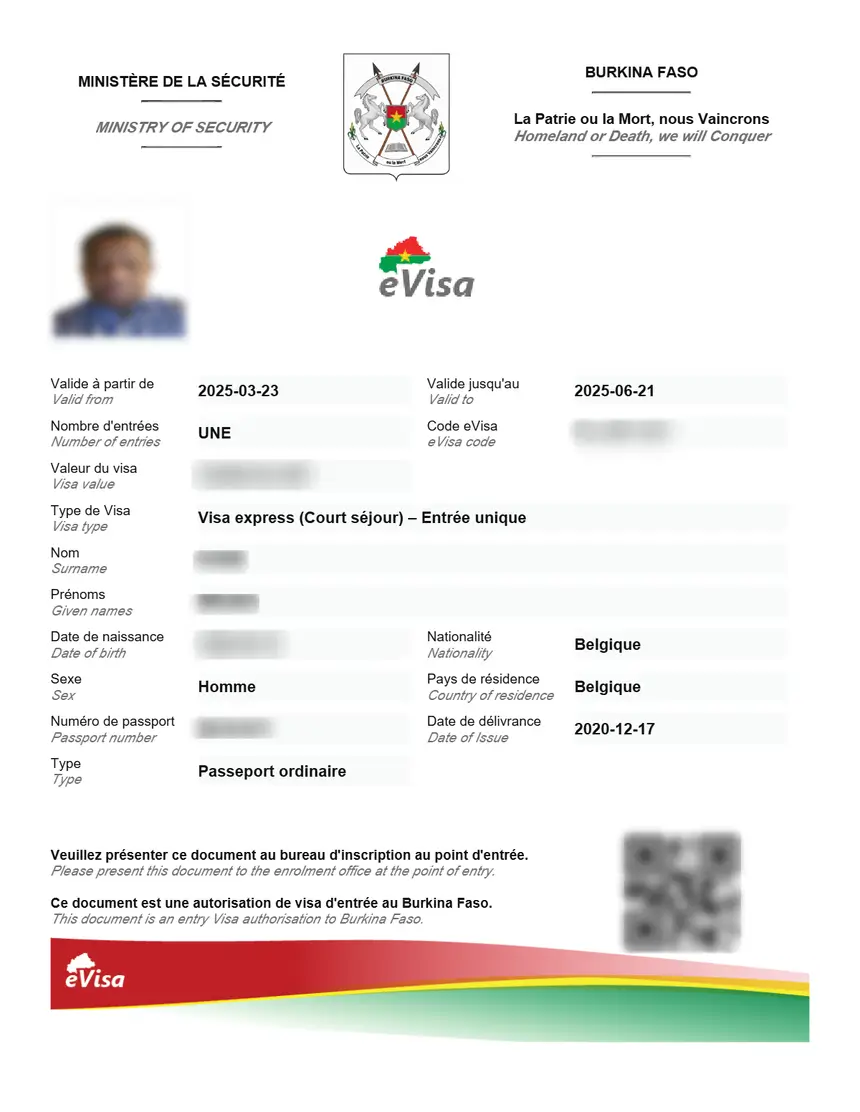
Option 1: eVisa Portal (Recommended)
The official eVisa portal at visaburkina.bf accepts long-stay visa applications from Nigerian citizens. The process is:
- Visit visaburkina.bf and create an account
- Select the long-stay visa category that matches your purpose
- Complete the online application form
- Upload required documents (passport scan, photos, supporting documents)
- Pay the visa fee by credit or debit card
- Wait for processing (typically 10 to 15 business days)
Option 2: Burkina Faso Embassy in Abuja
Contact the Embassy of Burkina Faso in Abuja for in-person applications. The embassy can provide guidance on specific requirements for Nigerian applicants.
Required Documents for Long-Stay Visa
- Valid Nigerian passport (6+ months validity, 2+ blank pages)
- Completed visa application form
- 2 passport-sized photographs (35mm x 45mm, white background)
- Proof of purpose (employment contract, university enrollment letter, family documents)
- Proof of accommodation in Burkina Faso
- Bank statement (last 3 months)
- Yellow fever vaccination certificate
- Police clearance certificate from Nigeria (for work visas)
For general visa requirements, see our Burkina Faso visa requirements guide.
Burkina Faso Embassy and Consulate in Nigeria
The Embassy of Burkina Faso in Abuja handles consular services for Nigerian citizens. Contact the embassy for:
- Long-stay visa applications and inquiries
- Verification of current entry requirements (especially regarding ECOWAS withdrawal developments)
- Emergency consular assistance for Nigerians in Burkina Faso
Embassy Contact Information
- City: Abuja, Nigeria
- Services: Visa applications, consular services, document authentication
- Recommended: Call or email before visiting to confirm current hours and requirements
Nigerian Embassy in Burkina Faso
Nigeria also maintains diplomatic representation in Ouagadougou. Nigerian citizens traveling to Burkina Faso can register with the embassy for:
- Emergency assistance
- Lost passport replacement
- Legal assistance if detained
Travel Tips for Nigerians Visiting Burkina Faso
Burkina Faso is a landlocked West African country with a French-speaking population, a tropical climate, and developing infrastructure. Nigerian travelers should prepare for cultural and logistical differences.
Language
- Official language: French – used in government, signs, and formal settings
- Local languages: Mooré (most widely spoken), Dioula, Fulfulde
- English: Very limited outside international organizations
- Practical tip: Learn basic French phrases or carry a translation app. Dioula is related to languages spoken in parts of Nigeria and may help in some areas
Safety
- Security situation: Burkina Faso has experienced security challenges, particularly in northern and eastern regions near the Mali and Niger borders
- Ouagadougou: The capital is generally safe for visitors with standard precautions
- Avoid: Northern regions, border areas with Mali and Niger, and areas where armed groups operate
- Check: The Nigerian Ministry of Foreign Affairs travel advisory before traveling
Health
In addition to the mandatory yellow fever vaccination, consider:
- Malaria prevention: Carry anti-malarial medication (Malarone or Doxycycline) and use mosquito repellent
- Routine vaccinations: Hepatitis A and B, typhoid, meningitis (recommended, not required)
- Travel insurance: Strongly recommended – medical facilities in Burkina Faso are limited compared to Nigeria
Climate
- Dry season (November – March): Hot and dry, temperatures 25-40 degrees Celsius
- Rainy season (June – October): Warm and humid, roads may be difficult to travel
- Harmattan (December – February): Dry, dusty winds from the Sahara – carry eye drops and a mask if sensitive
FAQs About Burkina Faso Visa for Nigerian Citizens
Do Nigerian citizens need a visa for Burkina Faso?
No. Nigerian citizens do not need a visa for Burkina Faso. As an ECOWAS member state, Nigeria benefits from the Protocol on Free Movement of Persons, which allows visa-free entry for stays of up to 90 days. You only need a valid Nigerian passport and a yellow fever vaccination certificate.
How long can Nigerians stay in Burkina Faso without a visa?
Nigerian citizens can stay in Burkina Faso for up to 90 days per visit without a visa under the ECOWAS free movement protocol. If you need to stay longer than 90 days, you must apply for a long-stay visa through the eVisa portal at visaburkina.bf or at the Burkina Faso Embassy in Abuja.
What documents do Nigerians need to enter Burkina Faso?
Nigerian citizens need: a valid passport with at least 6 months of remaining validity, a yellow fever vaccination certificate (original, not a copy), proof of accommodation (hotel booking or invitation letter), and evidence of sufficient funds for the stay. A return or onward ticket is recommended but not always checked.
Is there a direct flight from Nigeria to Burkina Faso?
No, there are no direct flights from Nigeria to Burkina Faso. The most practical route is via Lome (Togo) on ASKY Airlines, which takes 4-6 hours and costs approximately NGN 250,000-450,000. Other options include connecting through Abidjan (Cote d’Ivoire), Casablanca (Morocco), or Addis Ababa (Ethiopia).
Do Nigerians need a yellow fever vaccine to enter Burkina Faso?
Yes, a yellow fever vaccination certificate is mandatory for all travelers entering Burkina Faso, including Nigerian citizens. Get vaccinated at a Federal Ministry of Health quarantine center at least 10 days before travel. The certificate (yellow card) must be presented at the port of entry. Travelers without a valid certificate may be denied entry.
Can Nigerians work in Burkina Faso without a visa?
No. While Nigerians can enter Burkina Faso visa-free for up to 90 days, this does not authorize employment. To work legally in Burkina Faso, you need a long-stay work visa obtained through the eVisa portal or the Burkina Faso Embassy in Abuja, plus a work permit (carte de travail) from the Burkinabe Ministry of Labour.
How much money do I need to enter Burkina Faso from Nigeria?
There is no officially published minimum amount, but carrying the equivalent of at least 50,000 FCFA per day of your planned stay is recommended. For a 7-day trip, that is approximately 350,000 FCFA (roughly NGN 450,000). This can be in cash, bank cards, or a combination. Exchange NGN to EUR or USD in Nigeria, then convert to FCFA in Ouagadougou.
Is the ECOWAS visa-free arrangement still valid for Burkina Faso?
Yes, as of mid-2026, the ECOWAS free movement protocol continues to apply for Nigerian citizens traveling to Burkina Faso, even though Burkina Faso announced its withdrawal from ECOWAS in January 2024. However, this situation is evolving. Monitor news about the Alliance of Sahel States and check with the Burkina Faso Embassy in Abuja before traveling.
Can I travel overland from Nigeria to Burkina Faso?
Yes, it is possible to travel overland through Niger. The route goes Lagos – Abuja – Sokoto – Niger border – Niamey – Burkina Faso border – Ouagadougou. This takes 24-36 hours by road. However, this route is not recommended for first-time travelers due to security concerns in parts of Niger and poor road conditions.
What currency do I need in Burkina Faso?
Burkina Faso uses the West African CFA franc (FCFA). Nigerian naira cannot be directly exchanged in Burkina Faso. Convert NGN to EUR or USD at a bureau de change in Nigeria (Lagos or Abuja), then exchange to FCFA at banks or exchange offices in Ouagadougou. ATMs are available in Ouagadougou but may not accept all Nigerian bank cards.