
Travellers entering Burkina Faso must present a passport with at least 6 months validity and 2 blank visa pages, hold a valid visa (or qualify for ECOWAS visa-free entry), and show a yellow fever vaccination certificate at the immigration checkpoint. Missing any one of these documents means denial of entry.
Passport Requirements for Entering Burkina Faso
Every traveller entering Burkina Faso must carry a passport that meets strict validity rules. Your passport must be valid for at least 6 months beyond your planned entry date, and it must have at least 2 blank pages for visa stamps and entry seals.
These rules apply to all nationalities without exception. Even citizens of ECOWAS member states, who do not need a visa, must still present a passport that satisfies the 6-month validity rule. If your passport expires within 6 months of arrival, immigration officers will refuse entry and you will be placed on the next available departure flight at your own expense.
Check your passport before booking flights. If you have fewer than 2 blank pages or your passport expires within 6 months, renew it before travelling. Most passport renewal offices process applications in 2 to 4 weeks, but during peak travel season processing times can be longer.
Diplomatic and official passport holders follow the same validity rules, though some bilateral agreements may provide expedited immigration processing. Ordinary tourist and business passport holders face the full inspection at the checkpoint.
Visa Requirements – Who Needs a Visa for Burkina Faso?
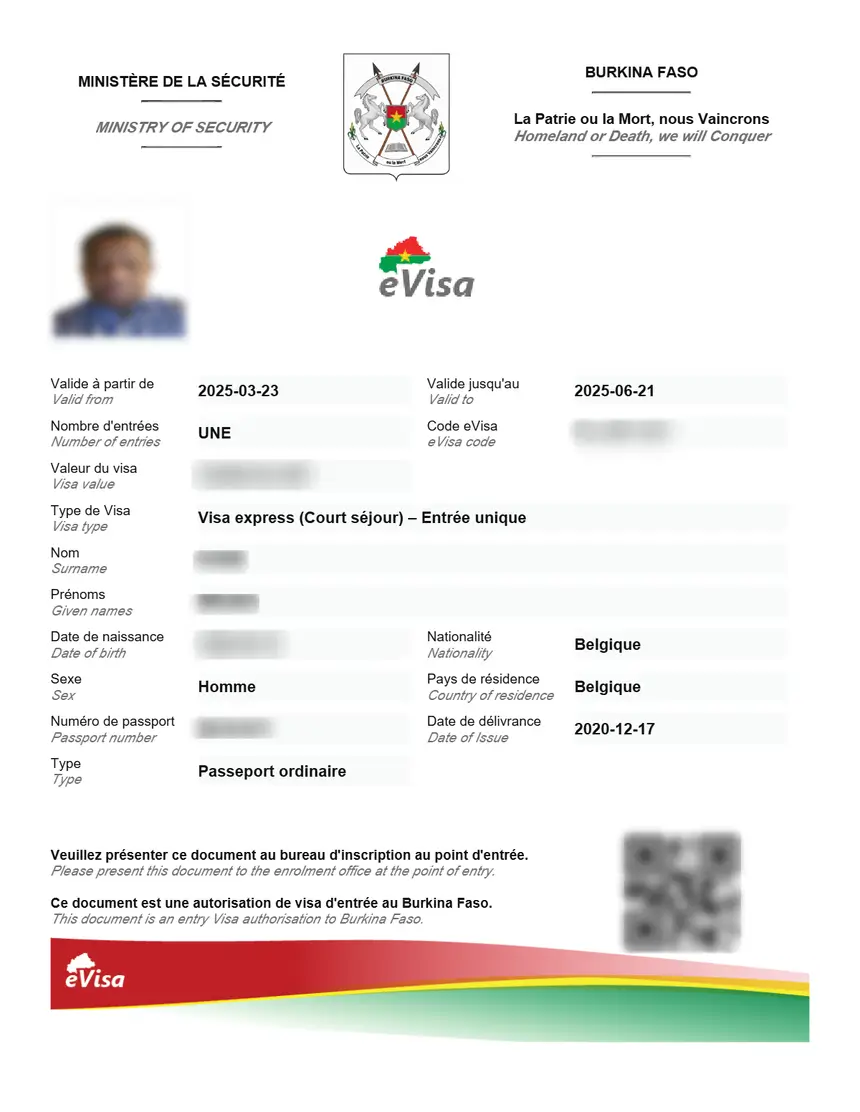
Most foreign nationals need a visa to enter Burkina Faso. The two main routes to obtain one are the eVisa portal (visaburkina.bf) or a Burkinabe embassy or consulate before departure. There is no visa-on-arrival facility for non-ECOWAS citizens.
ECOWAS nationals from the 15 member states can enter Burkina Faso without a visa for stays of up to 90 days. They need only a valid national passport or recognised travel document. The Economic Community of West African States (ECOWAS) free movement protocol guarantees this right, though travellers must still meet the passport validity and yellow fever certificate requirements.
All other nationalities must obtain a visa before arrival. The most convenient option is the eVisa, available at visaburkina.bf. The eVisa application requires a passport scan, a passport-sized photo, proof of accommodation, and a return or onward flight booking. Processing typically takes 3 to 5 business days. For more details on the online application, see the Burkina Faso eVisa guide.
If the eVisa is not suitable for your nationality or travel purpose, you can apply at the nearest Burkinabe embassy. Major embassies are located in Paris, Washington, London, and several West African capitals. Embassy processing takes 5 to 15 business days depending on the mission and visa category.
Visa types include tourist, business, transit, and long-stay categories. Each has different documentation requirements and validity periods. For a full overview, consult the Burkina Faso visa types page.
| Visa Category | Validity | Entries | Typical Fee |
|---|---|---|---|
| Tourist | 30 days | Single | ~50 EUR |
| Business | 90 days | Multiple | ~80 EUR |
| Transit | 7 days | Single | ~30 EUR |
| Long-stay | 1 year | Multiple | ~100 EUR |
Yellow Fever and Health Certificates
A valid yellow fever vaccination certificate is mandatory for all visitors entering Burkina Faso, regardless of nationality, age, or length of stay. The certificate is known formally as the International Certificate of Vaccination or Prophylaxis (ICVP), sometimes called the “yellow card.”
You must receive the yellow fever vaccine at least 10 days before your arrival in Burkina Faso. The vaccine is available at designated yellow fever vaccination centres in most countries. In the UK, these are listed on the NHS website. In the US, check the CDC’s travel health clinics directory. In India, government hospitals and approved private clinics provide the vaccination.
Since 2016, the World Health Organization (WHO) considers a single dose of the yellow fever vaccine to provide lifetime protection. This means your ICVP does not expire. If you received the vaccine years ago, the certificate remains valid.
Immigration officers at Ouagadougou International Airport and at all land border crossings check the yellow fever certificate as part of the standard entry procedure. If you cannot present a valid ICVP, you will be denied entry. Some travellers have reported being offered on-the-spot vaccination at the airport, but this is not guaranteed and should not be relied upon.
Other recommended (but not mandatory) vaccinations for Burkina Faso include hepatitis A, hepatitis B, typhoid, meningitis, and rabies. Consult a travel health clinic at least 6 weeks before departure for a full assessment.
The Arrival Process at Ouagadougou Airport
Arriving passengers at Ouagadougou International Airport (OUA) pass through four sequential checkpoints. Knowing the process in advance reduces waiting time and ensures you have all documents ready.
Step 1: Immigration Hall. After disembarking, follow signs to the immigration hall. Join the queue for foreign passport holders (separate from the ECOWAS citizens’ line). Have your passport, visa (or eVisa printout), and yellow fever certificate in hand.
Step 2: Document Inspection. The immigration officer checks your passport validity, confirms your visa or visa-free status, and reviews your yellow fever ICVP. The officer stamps your passport with the entry date and authorised length of stay. This step takes 2 to 5 minutes per passenger.
Step 3: Baggage Claim. Proceed to the baggage carousel for your flight. Luggage typically appears within 15 to 20 minutes of landing. If your bags are missing, file a report at the airline desk before leaving the baggage hall.
Step 4: Customs Inspection. All arriving passengers pass through customs. Most travellers with personal belongings pass through the green lane (nothing to declare). If you carry currency exceeding 25,000 CFA francs (approximately 38 EUR) or restricted items, use the red lane and complete a customs declaration form.
The total time from stepping off the plane to exiting the airport is typically 15 to 45 minutes, depending on queue lengths and the time of day. Early morning and late evening flights tend to have shorter queues.
Land Border Crossings Into Burkina Faso
Burkina Faso shares land borders with six countries: Ghana, Cote d’Ivoire, Mali, Niger, Benin, and Togo. Foreign nationals with valid visas can enter through designated border posts, though conditions vary by crossing and by the security situation in each region.
| Neighbouring Country | Main Crossing | Other Crossings | Notes |
|---|---|---|---|
| Ghana | Hamile | Bongo, Paga | Most popular for overland travellers |
| Cote d’Ivoire | Zeregbe | Koloko | Well-served by bus routes |
| Mali | Sikasso | Kona, Sideradougou | Check security advisories |
| Niger | Kantchari | – | Remote, limited facilities |
| Benin | Porga | – | Main route from Cotonou |
| Togo | Mandouri | – | Connects to Lome route |
Operating hours at most border posts are 06:00 to 18:00 local time. Some crossings, particularly the smaller ones, may close earlier or operate with reduced staff on weekends and public holidays.
At the border, you will present your passport, visa, and yellow fever certificate to immigration officers on both sides. Expect the process to take 30 to 60 minutes at busy crossings. Hamile (Ghana border) and Zeregbe (Cote d’Ivoire border) are the busiest and best-equipped posts, with money exchange services and transport connections on both sides.
For travellers transiting through Burkina Faso to reach another country, see the transit visa information for border-specific rules.
Customs Rules and Duty-Free Allowances
When entering Burkina Faso, you must observe customs regulations on what you can bring into the country duty-free and what items require declaration.
| Item | Duty-Free Limit |
|---|---|
| Spirits | 1 litre |
| Wine | 2 litres |
| Cigarettes | 200 (or 50 cigars) |
| Gifts | Up to 50,000 CFA value |
| Currency | Declare if over 25,000 CFA equivalent |
Currency declaration is required if you carry cash or travellers’ cheques exceeding 25,000 CFA francs (roughly 38 EUR) or the equivalent in foreign currency. Failure to declare can result in fines or confiscation. There is no upper limit on how much currency you can bring in, but amounts above the threshold must be declared on the customs form.
Prohibited items include narcotics, firearms and ammunition (without a permit), pornography, and counterfeit goods. Certain agricultural products, including fresh fruit and meat, may be restricted to prevent the spread of plant and animal diseases.
Electronics for personal use (laptop, phone, camera) are generally permitted without declaration. If you carry professional equipment or large quantities of goods, customs officers may ask you to pay import duties.
What Can Get You Denied Entry to Burkina Faso
Immigration officers at Ouagadougou airport and at land border crossings can refuse entry for several reasons. Understanding these in advance helps you prepare the correct documents.
Common reasons for denial:
- Invalid passport – less than 6 months validity or fewer than 2 blank pages
- Missing visa – no visa, eVisa, or evidence of ECOWAS visa-free status
- No yellow fever certificate – the single most common reason for denial at the border
- Overstay history – if you overstayed a previous visa, immigration records flag your passport
- Security concerns – watch-list flags or travel to restricted regions
- Insufficient proof of onward travel – no return ticket or evidence of departure plans
The consequences of denied entry are immediate. You are placed on the next available flight out of Burkina Faso, and the cost of the return ticket falls on you. In some cases, a temporary or permanent ban on future entry may be imposed.
To avoid denial: verify all documents before departure, carry printed copies of your eVisa confirmation, and ensure your yellow fever certificate is the original ICVP (not a photocopy).
Health and Safety Precautions at the Border
Beyond the mandatory yellow fever certificate, travellers should take several health precautions when entering Burkina Faso.
Malaria is present throughout the country year-round. Take antimalarial medication as prescribed by your doctor – common options include atovaquone-proguanil (Malarone), doxycycline, or mefloquine. Start the medication before arrival as directed on the prescription.
Water safety is critical. Drink only bottled or properly treated water. Avoid ice in drinks unless you are certain it was made from purified water. Carry oral rehydration salts in case of stomach illness.
Travel insurance with medical evacuation coverage is strongly recommended. Burkina Faso has limited medical infrastructure outside Ouagadougou. The main hospitals in the capital are CHU Yalgado Ouédraogo and CERBA (Centre de Recherche Biomoléculaire Appliquée). For serious injuries or illnesses, medical evacuation to Abidjan, Dakar, or Europe may be necessary.
Emergency numbers in Burkina Faso:
- 15 – SAMU (medical emergency)
- 17 – Police
- 18 – Fire brigade
Carry a basic medical kit including antimalarials, oral rehydration salts, antiseptic, bandages, and any prescription medications you take regularly. Pharmacies in Ouagadougou stock most common medications, but specific brands may not be available.
For the latest safety and security information, consult the Burkina Faso travel advisory page.
FAQ
What documents do I need to enter Burkina Faso?
You need a passport valid for at least 6 months with 2 blank pages, a valid visa (unless you are an ECOWAS national), and a yellow fever vaccination certificate (ICVP). Carry printed copies of your eVisa confirmation if you applied online.
Do I need a yellow fever certificate for Burkina Faso?
Yes. A valid yellow fever vaccination certificate is mandatory for all visitors, regardless of nationality. The certificate must be the original ICVP issued at least 10 days before travel. Since 2016, the WHO recognises a single yellow fever vaccination as providing lifetime protection.
Can I get a visa on arrival in Burkina Faso?
No. Burkina Faso does not offer visa-on-arrival for non-ECOWAS citizens. You must obtain a visa before departure, either through the eVisa portal at visaburkina.bf or from a Burkinabe embassy or consulate.
How long does immigration take at Ouagadougou airport?
The arrival process at Ouagadougou International Airport typically takes 15 to 45 minutes from stepping off the plane to exiting the airport. This includes immigration, baggage claim, and customs inspection.
What are the duty-free limits when entering Burkina Faso?
Duty-free allowances include 1 litre of spirits, 2 litres of wine, 200 cigarettes (or 50 cigars), and gifts up to 50,000 CFA francs in value. Currency exceeding 25,000 CFA must be declared.
Can I enter Burkina Faso by land from Ghana?
Yes. The main land border crossing between Ghana and Burkina Faso is at Hamile, with additional crossings at Bongo and Paga. Border posts are generally open from 06:00 to 18:00. You need a valid passport, visa (unless ECOWAS), and yellow fever certificate.
What happens if I arrive without a yellow fever certificate?
You will be denied entry. Immigration officers check the yellow fever certificate as a mandatory requirement. You will be placed on the next available departure flight at your own expense. Some airports may offer on-the-spot vaccination, but this is not guaranteed.
Do children need a visa for Burkina Faso?
Yes. Children of all ages need their own passport and visa (unless they hold ECOWAS nationality). Children must also have their own yellow fever vaccination certificate. Minors travelling without both parents may need additional documentation such as a notarised consent letter.
What items are prohibited at the Burkina Faso border?
Prohibited items include narcotics, firearms and ammunition (without a permit), pornography, and counterfeit goods. Certain agricultural products such as fresh fruit and meat may be restricted. If in doubt, declare items at the red customs lane.
Do I need travel insurance for Burkina Faso?
Travel insurance is not legally required for entry but is strongly recommended. Ensure your policy covers medical evacuation, as serious injuries or illnesses may require transfer to Abidjan, Dakar, or Europe. Burkina Faso has limited medical infrastructure outside Ouagadougou.