
If you are passing through Burkina Faso on your way to another country, you may need a transit visa. Burkina Faso issues a dedicated transit visa for travelers who are not staying in the country but need to cross its territory – whether by air, road, or rail. This guide explains who needs a transit visa, what it costs, how to apply, and what documents you need.
What Is a Burkina Faso Transit Visa?
A Burkina Faso transit visa is a short-term visa issued to foreign nationals who are traveling through Burkina Faso to reach a different destination country. It is not a tourist visa or a business visa – it exists specifically for travelers who need to enter and pass through Burkinabe territory.
Key features of the transit visa:
- Maximum validity: 5 days from the date of entry
- Purpose: Transit through Burkina Faso en route to another country
- Entry type: Single entry only
- Available via: Online eVisa portal, Burkinabe embassies, and at border immigration offices
The transit visa also doubles as an entry and stay visa for travelers whose transit is interrupted due to circumstances beyond their control, such as a vehicle breakdown, a missed connection, or other force majeure situations.
Who Needs a Transit Visa for Burkina Faso?
Most foreign nationals need a visa to enter Burkina Faso, even for transit. Whether you need a transit visa depends on two factors: your nationality and how you are transiting the country.
Air Transit (Connecting Flights)
If you are flying through Ouagadougou International Airport (OUA) and have a connecting flight to another country, you may or may not need a transit visa depending on whether you leave the international transit area:
- Staying in the transit zone: Some nationalities can remain in the airport’s international transit area without a visa. However, Burkina Faso’s airport facilities are limited, and not all connections guarantee sterile transit.
- Leaving the transit zone: If you need to collect luggage, change terminals, or exit the airport for any reason, you need a transit visa (unless you are from a visa-exempt country).
Overland Transit (Road or Rail)
If you are traveling by road through Burkina Faso – for example, driving from Ghana to Mali or from Cote d’Ivoire to Niger – you need a transit visa unless you hold a passport from a visa-exempt country. Overland transit requires crossing official border checkpoints, which means you are entering Burkinabe territory and must present valid immigration documents.
Visa-Exempt Nationalities
Citizens of ECOWAS (Economic Community of West African States) member states do not need a visa to enter or transit through Burkina Faso. ECOWAS member countries include:
Benin, Cabo Verde, Cote d’Ivoire, Gambia, Ghana, Guinea, Guinea-Bissau, Liberia, Mali, Niger, Nigeria, Senegal, Sierra Leone, and Togo.
Citizens of these countries can transit freely with a valid national ID card or passport.
For a complete list of visa-exempt nationalities, see our guide on Burkina Faso visa-free countries.
Burkina Faso Transit Visa Cost
The transit visa fee is set by Burkina Faso’s Direction Generale de la Police Nationale (Migration Division). As of 2026, the official costs are:
| Visa Type | Cost (FCFA) | Cost (USD approx.) | Duration |
|---|---|---|---|
| Transit visa (online eVisa) | 22,000 | ~$36 | Up to 5 days |
| Transit visa (embassy) | 22,000-38,000 | ~$36-$62 | Up to 5 days |
Additional costs to budget for:
- Express processing surcharge (if applying via eVisa): 104,500 FCFA (~$169) for 48-hour processing
- Stamp duty fees: Included in the visa fee for eVisa applications; may be separate at embassies
- Medical certificate: Varies by country – some embassies require a doctor’s examination
- Health insurance: Depends on your provider; must cover the transit period
Payment for the eVisa is made online by credit or debit card. Embassy applications may require a money order, bank transfer, or cash, depending on the specific embassy.
Required Documents for a Transit Visa
Applicants for a Burkina Faso transit visa must provide the following documents:
Mandatory Documents
- Valid passport – Must be valid for at least 6 months beyond your intended date of entry, with at least 2 blank pages
- Completed visa application form – Available from the eVisa portal (visaburkina.bf) or from the competent immigration authority
- Two recent passport-size photos – Color photos on a white background, measuring 3.5 x 4.5 cm, taken within the last 6 months
- Proof of onward travel – A confirmed flight ticket, bus ticket, or travel itinerary showing your destination country beyond Burkina Faso
- Medical certificate – A certificate from a licensed physician confirming you are not suffering from a contagious disease
- Health insurance certificate – Proof of health insurance coverage valid for the duration of your transit through Burkina Faso
- Visa fee payment receipt – Proof of payment of the applicable visa fees
Additional Documents for Overland Transit
If you are transiting by road, you must also provide:
- International driving permit (if driving)
- Vehicle registration document (carte grise) for the vehicle you are driving
- Vehicle insurance valid for Burkina Faso
Yellow Fever Vaccination
Burkina Faso requires all travelers to present a valid yellow fever vaccination certificate upon entry. This is a mandatory health requirement enforced at all border crossings and airports. If you cannot produce proof of yellow fever vaccination, you may be denied entry or required to get vaccinated on the spot.
Make sure your yellow fever vaccination was administered at least 10 days before your travel date.
How to Apply for a Burkina Faso Transit Visa
There are three ways to apply for a transit visa:
Option 1: Apply Online (eVisa)
The fastest and most convenient method is through Burkina Faso’s official eVisa portal.
Step 1: Visit visaburkina.bf and navigate to the visa application form (or go directly to applicant.visaburkina.bf)
Step 2: Select “Transit visa” as your visa type
Step 3: Fill in your personal details, passport information, and travel itinerary
Step 4: Upload the required documents (passport scan, photo, proof of onward travel, medical certificate, health insurance)
Step 5: Pay the visa fee online by credit or debit card
Step 6: Wait for the decision. Standard processing takes 3-10 business days. Express processing (48 hours) is available for an additional fee.
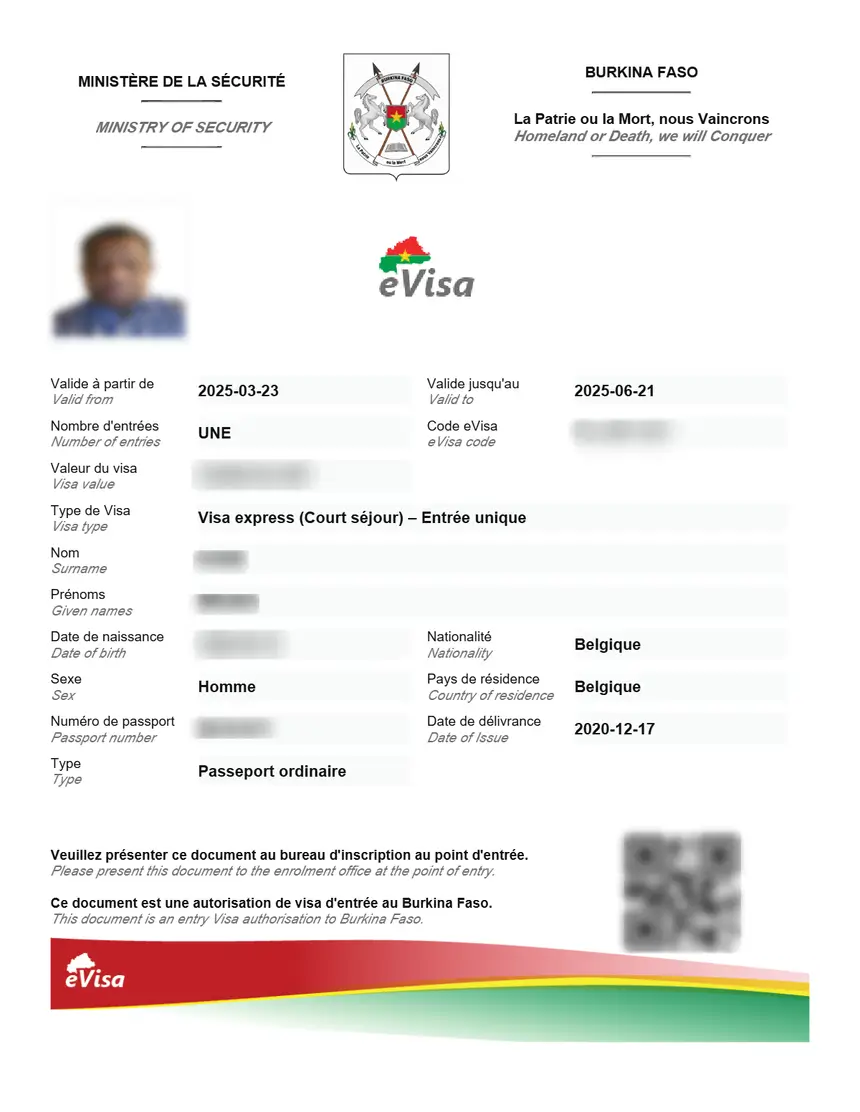
Step 7: If approved, you will receive the eVisa by email. Print a copy and carry it with your passport.
Apply for your transit visa at applicant.visaburkina.bf
Option 2: Apply at a Burkinabe Embassy
You can apply in person or by mail at a Burkina Faso embassy or consulate in your country. There are Burkinabe embassies in several countries, including:
- United States: Embassy of Burkina Faso, 2340 Massachusetts Avenue NW, Washington, DC 20008 – Phone: (202) 332-5577
- France: Ambassade du Burkina Faso, 159 Boulevard Haussmann, 75008 Paris
- United Kingdom: Burkina Faso does not currently have an embassy in the UK; the Paris embassy covers UK-based applicants
- Ghana: Ambassade du Burkina Faso, Accra
- Cote d’Ivoire: Ambassade du Burkina Faso, Abidjan
Embassy processing typically takes 5-10 business days. Contact the nearest embassy for specific requirements and appointment availability.
Option 3: Apply at the Border
In some cases, travelers can obtain a visa at border immigration offices upon arrival. However, this option is not recommended for transit visas because:
- Processing at the border can take several hours
- Not all border crossings process visa applications
- You may be denied entry if documentation is incomplete
- There is no guarantee the transit visa type will be available on arrival
If you plan to transit through Burkina Faso, apply for your visa in advance through the eVisa portal or an embassy.
Transit Visa vs Other Visa Types
Understanding the difference between a transit visa and other Burkina Faso visa types helps you apply for the right one:
| Feature | Transit Visa | Short-Stay Visa | Long-Stay Visa |
|---|---|---|---|
| Maximum stay | 5 days | 30-90 days | Up to 1 year |
| Purpose | Passing through | Tourism, business | Work, study, family |
| Cost | 22,000 FCFA | 33,000-93,500 FCFA | Varies |
| Entry type | Single | Single or multiple | Single or multiple |
| Extension possible | No | Yes (at immigration) | Yes |
When to choose a transit visa: You are traveling through Burkina Faso to reach another country and will stay 5 days or less.
When to choose a short-stay visa instead: You plan to stay in Burkina Faso for tourism, a business meeting, or any purpose beyond simple transit. Even a brief stopover of a few days for sightseeing requires a short-stay visa, not a transit visa.
For more details on all visa types, see our guide on Burkina Faso visa types.
Common Transit Routes Through Burkina Faso
Burkina Faso is a landlocked country in West Africa, bordered by six countries. Common transit routes include:
By Air
- Ouagadougou Airport (OUA) is the main international hub. Airlines such as Air Burkina, Ethiopian Airlines, ASKY Airlines, and Air Cote d’Ivoire operate regional connections. Transit through OUA is common for travelers heading between West African capitals.
By Road
- Ghana to Mali: Cross Burkina Faso via Ouagadougou. The main route runs from Bolgatanga (Ghana) through Ouagadougou to the Mali border near Bobo-Dioulasso.
- Cote d’Ivoire to Niger: Cross southern Burkina Faso from the western border near Banfora to the eastern border toward Niamey.
- Togo to Mali: Enter from the southeast and exit toward the west.
Travel Time by Road
- Ouagadougou to the Ghana border: approximately 3-4 hours
- Ouagadougou to the Mali border: approximately 5-6 hours
- Ouagadougou to the Niger border: approximately 4-5 hours
If you are driving through, plan for border processing time at both entry and exit points, which can add 1-3 hours per crossing.
Important Considerations for Transit Travelers
Security Situation
Burkina Faso faces significant security challenges, particularly in the northern and eastern regions. If you are transiting by road, stick to major highways and avoid traveling after dark. Check your government’s travel advisory before departure.
Currency
The local currency is the West African CFA franc (FCFA/XOF), which is pegged to the euro. ATMs are available in Ouagadougou and Bobo-Dioulasso, but may not be reliable in rural areas. Carry sufficient cash for your transit, including funds for fuel, food, and any unexpected delays.
Language
French is the official language. English is not widely spoken outside of international hotels and airports. If you do not speak French, have key phrases written down or use a translation app.
Mobile Connectivity
Local SIM cards are available from providers like Orange Burkina and Moov Africa. If you are only transiting, check whether your home carrier offers roaming coverage in Burkina Faso before buying a local SIM.
Frequently Asked Questions
Can I transit through Burkina Faso without a visa?
Only citizens of ECOWAS member states can transit without a visa. All other nationalities need at least a transit visa unless they qualify for another exemption.
How long is the transit visa valid?
The transit visa is valid for a maximum of 5 days. It cannot be extended. If you need to stay longer, you must apply for a short-stay visa.
Can I get a transit visa at Ouagadougou Airport?
In some cases, transit visas may be available on arrival at Ouagadougou Airport, but this is not guaranteed. Apply online in advance to avoid delays or denial of boarding by your airline.
What if my transit is delayed beyond 5 days?
If your transit is interrupted due to circumstances beyond your control (vehicle breakdown, missed connection, or other force majeure), the transit visa can function as a temporary stay visa. Contact the local immigration office immediately if this happens. You will need to explain the circumstances and may need supporting documentation.
Do I need a yellow fever vaccination for transit?
Yes. Burkina Faso requires proof of yellow fever vaccination for all travelers entering the country, including those in transit. This is enforced at airports and land border crossings.
Can I leave the airport during a transit?
If you leave the airport’s international transit zone, you are entering Burkina Faso and must have a valid visa. A transit visa allows you to leave the airport, but only for the purpose of continuing your journey to the next country.
How much does a Burkina Faso transit visa cost?
The transit visa costs 22,000 FCFA (~$36 USD) through the online eVisa system. Embassy fees may vary slightly. Express processing adds 104,500 FCFA (~$169) for 48-hour turnaround.
Can I apply for a transit visa if I am from the United States?
As of 2026, US citizens face a visa suspension for Burkina Faso due to diplomatic tensions. Transit visa applications from US passport holders may be denied. Check the current status with the nearest Burkinabe embassy before applying.