Choosing between the online eVisa portal and a Burkina Faso embassy determines how long your application takes, how much you pay, and whether you need to hand over your passport. For most short-stay travellers, the eVisa at visaburkina.bf is faster and cheaper. The embassy route is mandatory for long-stay visas and for nationalities not eligible for the online system. This guide compares both channels across every factor that matters – processing time, cost, convenience, visa types, and document handling – so you can pick the right method for your trip.
What Is the Burkina Faso eVisa?
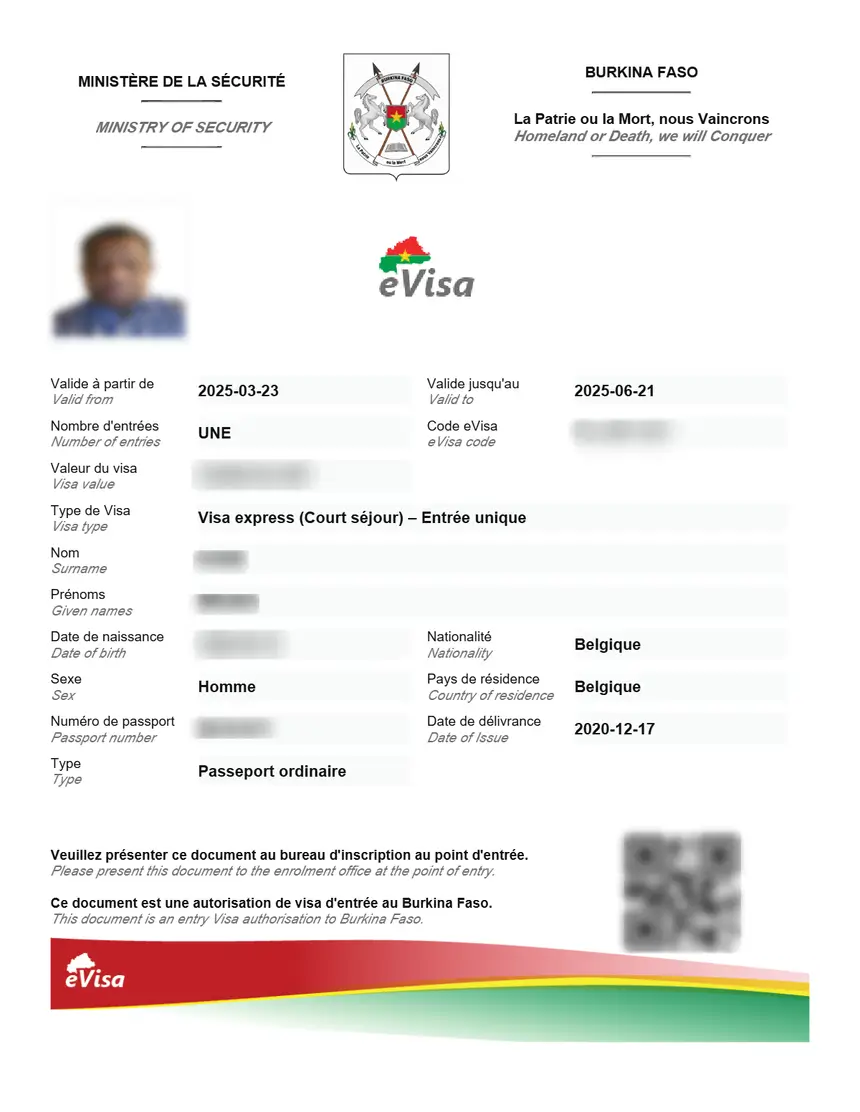
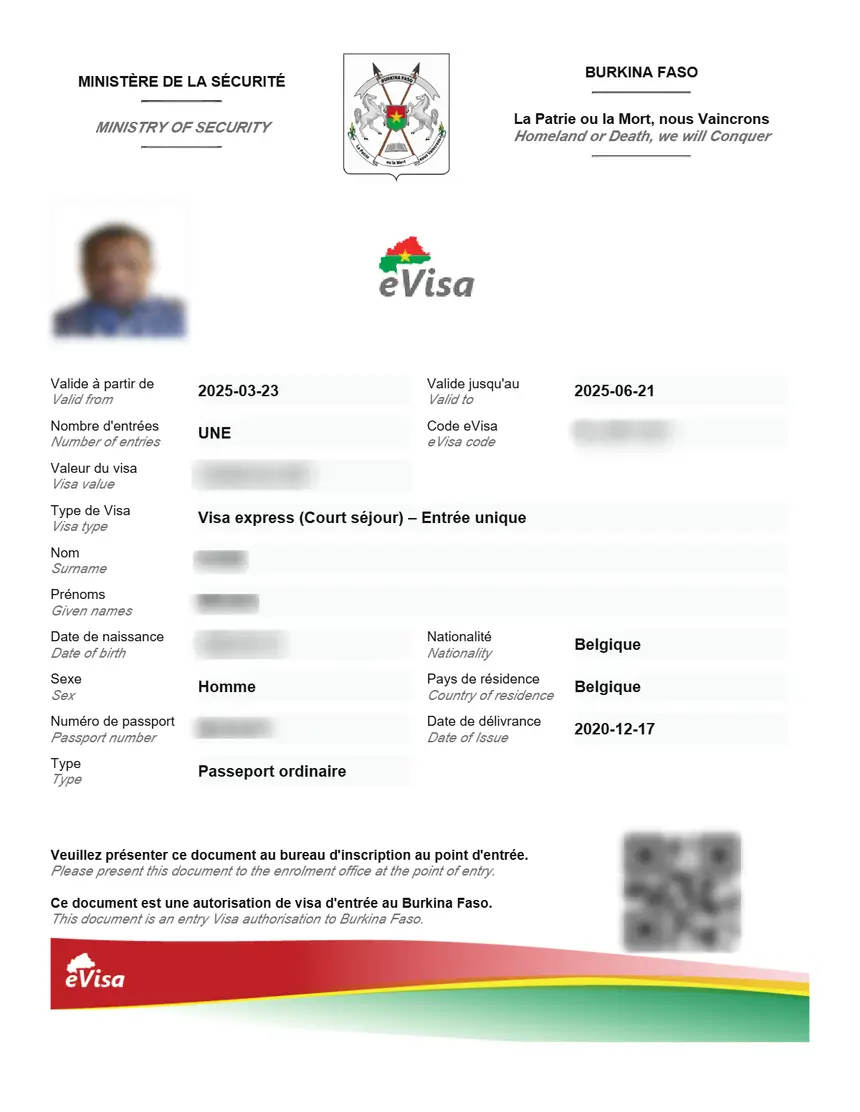
The Burkina Faso eVisa is an electronic pre-approval issued through the government portal at visaburkina.bf. Launched in 2014 and expanded in August 2023, the system lets travellers from eligible countries submit applications, upload documents, and pay fees entirely online without visiting a diplomatic mission.
The eVisa covers short-stay tourist, business, and transit visas. Standard processing takes 3 to 5 business days, with an express option that guarantees 48-hour turnaround for an additional fee. Once approved, you download a PDF approval letter, print it, and present it at the immigration counter upon arrival in Burkina Faso, where officers stamp your passport with the actual visa.
Key features of the eVisa system include:
- No passport surrender – you keep your passport throughout the process
- Online payment – credit card, debit card, or mobile money (Orange Money, Moov Money)
- Digital document upload – passport scan, photo, yellow fever certificate, accommodation proof
- Application from anywhere – no need to be in or near a specific country
- Status tracking – log in at applicant.visaburkina.bf to check progress
For a step-by-step walkthrough of the online application, see our Burkina Faso eVisa guide.
What Is the Embassy Visa Route?
Applying at a Burkina Faso embassy means submitting your application in person (or sometimes by mail) at a Burkinabe diplomatic mission. Burkina Faso maintains embassies and consulates in over 30 countries across Africa, the Americas, Asia, and Europe, including major missions in Washington, D.C., Brussels, Ottawa, Abuja, and Beijing.
The embassy route handles all visa categories – tourist, business, transit, and long-stay (work, student, family reunification, investor). It is the only channel for long-stay visas and for nationalities that cannot use the eVisa portal.
The embassy application process involves:
- Contacting the embassy to confirm appointment availability, fees, and jurisdiction
- Preparing physical documents – passport, application form, photos, yellow fever certificate, accommodation proof, bank statements
- Submitting in person – some embassies accept mail applications with a prepaid return envelope
- Paying fees – cash, money order, or bank transfer (credit cards rarely accepted)
- Waiting for processing – typically 5 to 15 business days, with some embassies offering expedited service
- Collecting your passport – you must surrender it during processing
For the full list of embassies and step-by-step instructions, see our Burkina Faso embassy guide.
eVisa vs Embassy: Side-by-Side Comparison
The table below compares both channels across the factors that matter most to applicants:
| Factor | eVisa Portal | Embassy |
|---|---|---|
| Visa types | Tourist, business, transit (short-stay only) | All types including long-stay |
| Processing time | 3-5 business days | 5-15 business days |
| Express option | Yes – 48 hours | Varies by embassy |
| Application method | Online from anywhere | In person (some by mail) |
| Fee payment | Card or mobile money | Cash, money order, bank transfer |
| Passport handling | Keep your passport | Surrender during processing |
| Appointment needed | No | Usually yes |
| Document format | Digital scans (JPEG/PDF) | Physical copies |
| Best for | Quick tourist/business trips | Long-stay, complex cases |
| Availability | 24/7 online | Embassy business hours |
| Location dependency | Apply from anywhere | Must visit or mail to embassy |
Processing Time: eVisa vs Embassy
Processing speed is one of the biggest differences between the two channels.
eVisa processing takes 3 to 5 business days for standard applications. The express surcharge of 104,500 FCFA (~$169) guarantees a decision within 48 hours. Most applications are processed within 5 business days, though incomplete documents or additional security checks can extend the timeline.
Embassy processing takes 5 to 15 business days from the date of submission. Some embassies offer expedited processing for an additional fee, reducing the wait to 2-5 business days. During peak travel seasons (November to February, and around religious holidays), embassy processing may take longer due to higher application volumes.
| Processing Speed | eVisa | Embassy |
|---|---|---|
| Standard | 3-5 business days | 5-15 business days |
| Express / Expedited | 48 hours | 2-5 business days (where available) |
| Peak season impact | Minimal | Can extend by 5+ days |
If you are travelling within 2 weeks, the eVisa is the safer choice. If you need a long-stay visa, you must use the embassy and should apply at least 4-6 weeks before your travel date. For a detailed breakdown, see our Burkina Faso visa processing time guide.
Cost Comparison: eVisa vs Embassy Fees
Fees vary by visa type and application channel. The eVisa portal displays the exact amount during the application process. Embassy fees may differ slightly between missions.
| Visa Type | eVisa Fee | Embassy Fee | Difference |
|---|---|---|---|
| Tourist (30 days, single) | 33,000 FCFA (~$53) | $80-$100 | Embassy costs more |
| Tourist (90 days, multiple) | 55,000 FCFA (~$89) | $120-$150 | Embassy costs more |
| Business (90 days) | 77,000-93,500 FCFA (~$124-$151) | $120-$150 | Similar |
| Transit (5 days) | 22,000 FCFA (~$36) | $50-$70 | Embassy costs more |
| Long-stay (work) | Not available | $178-$267 | Embassy only |
| Long-stay (student) | Not available | $142 | Embassy only |
| Express surcharge | +104,500 FCFA (~$169) | Varies | – |
For short-stay visas, the eVisa is generally $20-$50 cheaper than embassy fees. The eVisa also eliminates hidden costs like travel to the embassy, parking, time off work, and postage for mail applications. For a full fee breakdown by nationality, see our Burkina Faso visa fee guide.
Note: All fees are non-refundable regardless of the outcome. This applies to both channels.
When You MUST Use the Embassy
The eVisa portal does not cover every situation. You must apply at an embassy if:
- You need a long-stay visa – work, student, family reunification, or investor visas are only available through embassies
- Your nationality is not eligible for the eVisa – some countries are excluded from the online system
- You have a complex case – previous visa denials, dual nationality, or special travel purposes may require in-person assessment
- You need a visa stamp before travel – some connecting countries require a physical visa in your passport, not just an eVisa approval letter
- The eVisa portal is temporarily unavailable – system maintenance or technical issues can take the portal offline
If your country does not have a Burkina Faso embassy, you can apply at the nearest mission in a neighbouring country. Many applicants from countries without a Burkinabe embassy travel to Abuja, Accra, or Brussels to submit their applications.
For long-stay visa requirements and documents, see our Burkina Faso long-stay visa guide.
When the eVisa Is the Better Choice
For most short-stay travellers, the eVisa is the clear winner. Choose the online portal if:
- You are applying for a tourist or business visa – the eVisa handles these efficiently
- You want the fastest processing – 3-5 days standard, 48 hours express
- You do not live near an embassy – apply from anywhere with an internet connection
- You prefer card payment – no need for cash or money orders
- You want to keep your passport – the eVisa does not require passport surrender
- You need flexibility – apply 24/7, track status online, download approval instantly
The eVisa is particularly convenient for travellers from countries like the United States, United Kingdom, India, and Canada, where Burkina Faso embassies may be far from major cities or have long appointment wait times. For country-specific guidance, see our pages on Burkina Faso visa for US citizens, UK citizens, and Indian citizens.
Document Requirements: What Changes Between Channels
Both channels require the same core documents, but the format and handling differ:
| Document | eVisa | Embassy |
|---|---|---|
| Passport | Digital scan (JPEG/PDF, max 2 MB) | Physical passport surrendered |
| Photo | Digital passport photo (white background) | 2 printed passport photos |
| Yellow fever certificate | Digital scan | Physical original |
| Accommodation proof | Hotel booking PDF or scan | Printed reservation or invitation letter |
| Bank statement | Digital scan | Printed statement (last 3 months) |
| Application form | Filled online | Paper form (downloaded or obtained at embassy) |
Key difference: The eVisa accepts digital scans of all documents, while embassies require physical copies. If your documents are already digital, the eVisa saves you printing and photocopying costs. For the full document checklist, see our Burkina Faso visa requirements page.
Can You Use Both Channels?
Yes. There is no rule preventing you from applying through both channels, though it is rarely practical. Some travellers start with the eVisa and switch to the embassy if:
- The eVisa is rejected and they want to reapply in person
- Their travel dates are too close for eVisa processing
- They discover they need a visa type not available online
If you have already submitted an eVisa application and want to apply at an embassy instead, you do not need to cancel the eVisa application. The embassy processes your application independently. However, you will pay fees twice – once for the eVisa and once for the embassy application.
ECOWAS Nationals: Neither Channel Needed
Citizens of the 15 ECOWAS member states (Benin, Cabo Verde, Cote d’Ivoire, Gambia, Ghana, Guinea, Guinea-Bissau, Liberia, Mali, Niger, Nigeria, Senegal, Sierra Leone, and Togo) do not need a visa for stays of up to 90 days in Burkina Faso. They can enter with a valid national passport and a yellow fever certificate.
Since September 2025, ECOWAS nationals are also exempt from visa fees for any visa category. For long-stay stays exceeding 90 days, ECOWAS citizens can apply for a residence permit at the immigration office in Ouagadougou without needing to visit an embassy.
For more on visa-free entry, see our Burkina Faso visa-free countries guide and the Africa free visa policy page.
African Union Free Visa Policy
In addition to ECOWAS exemptions, Burkina Faso participates in the African Union free visa policy announced in 2025. Citizens of several non-ECOWAS African countries can now enter Burkina Faso without a visa for short stays. This policy further reduces the need for both eVisa and embassy applications for African travellers. Check the Africa free visa policy page for the current list of eligible nationalities.
Decision Guide: Which Channel Should You Choose?
Use this quick decision guide to pick the right channel:
Choose the eVisa if:
– You need a tourist, business, or transit visa
– Your nationality is eligible for the online portal
– You want processing in 3-5 days (or 48 hours express)
– You prefer online payment by card
– You want to keep your passport during processing
Choose the embassy if:
– You need a long-stay visa (work, student, family)
– Your nationality is not eligible for the eVisa
– You have a complex case (previous denials, dual nationality)
– You prefer in-person assistance
– You need a physical visa stamp before travel
You may not need either if:
– You are an ECOWAS national (visa-free for 90 days)
– You qualify under the African Union free visa policy
– You are transiting through Ouagadougou Airport without leaving the international zone
Frequently Asked Questions
Is the eVisa cheaper than the embassy visa?
Yes, for short-stay visas the eVisa is generally $20-$50 cheaper than embassy fees. A 30-day tourist eVisa costs 33,000 FCFA (~$53) compared to $80-$100 at an embassy. The eVisa also eliminates travel costs to the embassy. Long-stay visas are only available through embassies, so there is no direct price comparison for those categories.
Can I switch from eVisa to embassy after applying?
Yes. If your eVisa application is rejected or taking too long, you can apply at an embassy without cancelling the eVisa application. You will pay fees twice, but the embassy processes your application independently. Some travellers use the embassy as a backup when their eVisa is under review close to their travel date.
Which is faster – eVisa or embassy?
The eVisa is faster. Standard eVisa processing takes 3-5 business days, with a 48-hour express option. Embassy processing takes 5-15 business days standard, with expedited options varying by mission. If speed is your priority, the eVisa with express processing is the fastest route.
Do I need to visit the embassy in person?
For the eVisa, no – the entire process is online. For embassy applications, most missions require or strongly recommend in-person submission. Some embassies accept applications by mail with a prepaid return envelope. Contact your nearest embassy to confirm their specific policy.
What if my country has no Burkina Faso embassy?
You have three options: (1) apply at the nearest Burkina Faso embassy in a neighbouring country, (2) use the eVisa portal if your nationality is eligible, or (3) use a visa expediting service. Many applicants travel to Abuja, Accra, or Brussels for embassy applications.
Can I get a long-stay visa through the eVisa portal?
No. Long-stay visas (work, student, family reunification, investor) are only available through embassies. The eVisa portal handles tourist, business, and transit visas only. If you need a long-stay visa, visit our Burkina Faso long-stay visa guide for embassy-specific instructions.
Is the eVisa accepted at land border crossings?
Yes. The eVisa is valid at all official ports of entry, including Ouagadougou International Airport and approved land border crossings with Ghana, Cote d’Ivoire, Niger, Mali, Benin, and Togo. Confirm your intended port of entry in the application form.
What happens if both my eVisa and embassy application are rejected?
Visa rejections can happen through either channel. Common reasons include incomplete documents, passport validity issues, or security concerns. You can reapply after addressing the rejection reason. Fees are non-refundable in both cases. If rejected twice, consider consulting a visa agency or the embassy directly for guidance on your specific situation.
Do children need to apply through the same channel as adults?
Yes. Every traveller, including infants and children, needs their own visa application and passport. Children cannot be included on a parent’s eVisa or embassy application. The same channel choice applies – use the eVisa for short-stay travel or the embassy for long-stay visas. Minors under 16 are typically not required to appear in person at the embassy; a parent or guardian can submit on their behalf.
Can I apply at any Burkina Faso embassy, or only the one in my country?
You can generally apply at any Burkina Faso embassy worldwide. However, some embassies prioritise applicants from their designated jurisdiction. If you apply outside your home country, the embassy may ask for additional documentation. The eVisa portal has no such restrictions – you can apply from anywhere.